
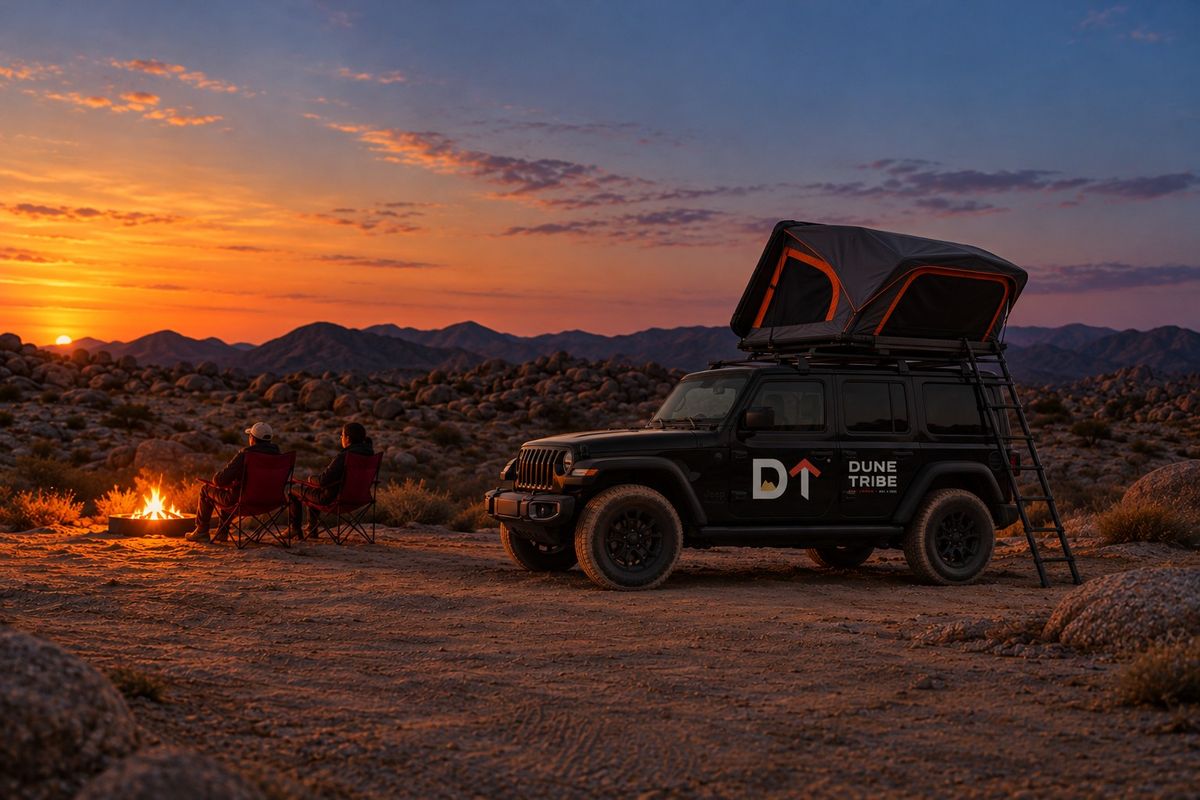
What you get: the car and the camping kit
Every car is an automatic 4x4 with low range. The tent, the whole kit and unlimited kilometres are included in the daily price; you add food, water and fuel.
- Sleep: hard-shell rooftop tent with mattress, bed linen (sheets and a pillow for each traveller), and an LED lantern with tripod.
- Cook: an electric fridge with a separate freezer compartment, a gas stove with cartridges, pots, a frying pan, a kettle, and plates, mugs and cutlery for 4.
- Camp: a folding chair for each traveller, a table, a BLUETTI power station (600 W, 320 Wh), a phone holder and a portable shower (21 L).
- Off-road and safety: tyre compressor, recovery boards, recovery rope, jump starter and first-aid kit.
Rooftop tent Oman: how the tent works
The tent sits closed on the roof while you drive. At camp you unclip two latches and the hard shell lifts on gas struts. It takes about a minute. At pick-up we open it together with you, so you have done it once before the first night.
The standard tent sleeps 2 adults. From 15 December 2026 we also rent one Family tent Wrangler for 2 adults and 2 children, or 3 adults. Its tent measures 208 × 196 cm when open and comes with a side awning for shade. It is a single car, so ask early. With a standard tent, a group of four can add a ground tent for two more people; its price is on request.
Park on level ground before you open the tent: you feel every slope on the mattress. On the coast and on open plains the wind can be strong, so use the car as a windbreak when you cook. Never light a fire or use the stove in or on the tent.
Where you can sleep in Oman
Wild camping on public land is allowed and common in Oman: there is no general ban. For a night or two you normally need no permit outside Muscat Governorate. Some municipalities license longer seasonal camps, such as the winter camps in North and South Al Batinah, and Dhofar has its own rules in the khareef season, so follow local signs.
In the Wahiba Sands you can also stay at a desert camp. Ask a camp whether you may sleep in your own tent and pay for dinner or a shower. Our guide to camping rules and permits in Oman has the details. These places and rules matter most:
- Muscat Governorate: camp only at sites the municipality allows; it publishes a map of them. Stays of more than 48 hours need a permit, with a refundable OMR 100 deposit. Stay at least 10 m from the beach and 100 m from homes, and away from fishing areas. Fires and barbecues on beaches and green areas are not allowed. Camping without a permit is fined OMR 200, and other breaches OMR 50.
- Nature reserves: wild camping is not allowed inside reserves such as the Ras al Hadd turtle reserve, and entering a turtle reserve at night needs a permit. In the Jabal Akhdar Scenic Reserve, camping or staying overnight needs a permit from the Environment Authority.
- Wadi beds: never camp in one. Rain far away in the mountains can send a flash flood down a dry valley.
- Villages and farms: camp out of sight of houses, and keep off farms and private land.
- Wood and rubbish: collecting firewood needs a permit from the Environment Authority. Cook on the gas stove and take all rubbish with you.
Driving basics
Royal Oman Police allows visitors to drive with a licence from their home country for tourism or transit, during a visit of up to three months. We ask for your national licence and passport, and an International Driving Permit if Oman requires one for your licence. Tell us the country of your licence, and we confirm before you book whether you also need a permit. The minimum age is 21, and up to 2 additional drivers are free.
- Where our cars may go: paved roads and mountain roads, and in daylight existing gravel, rocky and sand tracks, open dunes and beaches. Drive on a beach only where the law and local signs allow it: never in a turtle reserve, and never where a sign closes the beach to cars, as on some beaches in Muscat. Never drive in a wadi, in its bed or on a track through or along it; a paved road across or beside a wadi, or to a wadi's car park, is fine. Trips outside Oman are not allowed. If you are not sure about a track, ask us before you drive it.
- Sand: before you drive on sand, lower the tyres to about 18–20 psi (1.2–1.4 bar), use low range in soft sand, and pump the tyres back up with the compressor before you drive on tarmac. Check the tide before you drive on a beach. If you have never driven on sand, start with small dunes or take a local guide. Our guide to tyre pressure and sand driving in the Wahiba Sands has the details.
- Mountains: a police checkpoint on the road up Jebel Akhdar lets only 4x4 vehicles continue. Use a low gear on the way down.
- Wadis: never drive into flowing water. Under Article 49 of the Traffic Law, crossing a wadi in a way that puts lives at risk can mean up to three months in prison, a fine of up to OMR 500, or both.
- Fuel: as of October 2026, OOMCO listed petrol at 229 baisa a litre (M91) and 239 baisa (M95). Fill up before every sand track and mountain road.
When to go
October to April is the season. At Muscat airport the average daily high is about 25–30 °C from November to March and about 35 °C in October and April. In May and June it is close to 40 °C (1991–2020 averages).
Desert nights can be cold and windy, and in the mountains it can freeze: Jebel Shams recorded −2.1 °C in January 2026. The kit has sheets and a pillow for each traveller, and we provide sleeping bags on request: from December to February, ask us for them before you travel. Pack warm layers as well as summer clothes.
Prices and what to book
Our daily prices are in Omani rials. They include 5% VAT, the rooftop tent, the camping kit and the Basic damage package. The minimum rental is 3 days. We count rental days as the nights between pick-up and return, so Monday to Thursday is 3 days: OMR 165 in a Wrangler.
Every car has third-party insurance with Dhofar Insurance. It does not pay for damage to the rental car: for that, a damage package sets the most you pay. The packages limit what you owe us; they are not insurance. With Basic, which is included, the most you pay for most accidents is OMR 500. Plus costs OMR 5 a day more (maximum OMR 250). With Basic and Plus, a rollover or an accident with no other vehicle involved costs up to OMR 1,500, and you pay for tyres, glass and underbody at cost. Full costs OMR 12 a day more: the maximum is OMR 100, also for a rollover, and up to 2 tyres, 1 windscreen and the underbody are included. No package covers damage where our terms do not allow driving, on tracks, dunes or beaches after dark, in a wadi bed or on a wadi track, or in water: then you pay the full cost. The insurance section of our rental contract has the full rules.
Pick-up and return are at Muscat International Airport or at a hotel or address in Muscat, at no extra cost, between 08:00 and 20:00. You book online: choose your dates and pay the deposit by card. You pay 30% to confirm and the balance at pick-up. The security deposit is a hold on your card at pick-up, or cash with a receipt: OMR 500, 250 or 150, depending on the package. The daily prices:
- Jeep Wrangler with a rooftop tent for two: OMR 55 a day.
- Wrangler with the Family tent (2 adults and 2 children, or 3 adults): OMR 65 a day, from 15 December 2026.
- Land Cruiser Prado 2024 with a rooftop tent for 2 adults and 2 children, or 3 adults (the Family tent): OMR 75 a day, available from January 2027.
Choosing a route
Three or four days are enough for one region: our short loop to the dunes and wadis, or three days in the mountains around Jebel Akhdar and Jebel Shams. Seven days cover the coast, the desert and the mountains on our one-week loop from Muscat. With 20 days or more you can drive south to Dhofar and Salalah. Each itinerary lists camp spots and fuel stops.